The individual child
Children bring different bodies, identities, developmental stages, capabilities, health needs, neurodiversity, histories, preferences and forms of agency to the same school setting.
Research
The program investigates how time, weather, space, materials, relationships, rules and organisational decisions shape children’s experiences and teachers’ work. It connects play, movement, climate and school environments with decisions made by schools and education systems.
Central proposition
Access to shade, time for breaks, available materials, supervision and everyday rules can change what children are able to do. The program examines how these conditions work together.
Children experience school conditions differently. Their bodies, identities, agency and lived experiences inform how the research examines participation, belonging and health.
Place and reach
Australia provides a consequential setting for studying climate, regional variation, school-system diversity and unequal access to supportive environments.
The wider research questions travel across countries. How do different climates, cultures, systems and communities shape the conditions through which children and teachers experience school?
Conditions around the child
An ecological perspective, informed by Bronfenbrenner’s ecological systems theory, directs attention to people, relationships, environments and organisational decisions. Individual studies use the concepts and methods appropriate to their research questions.
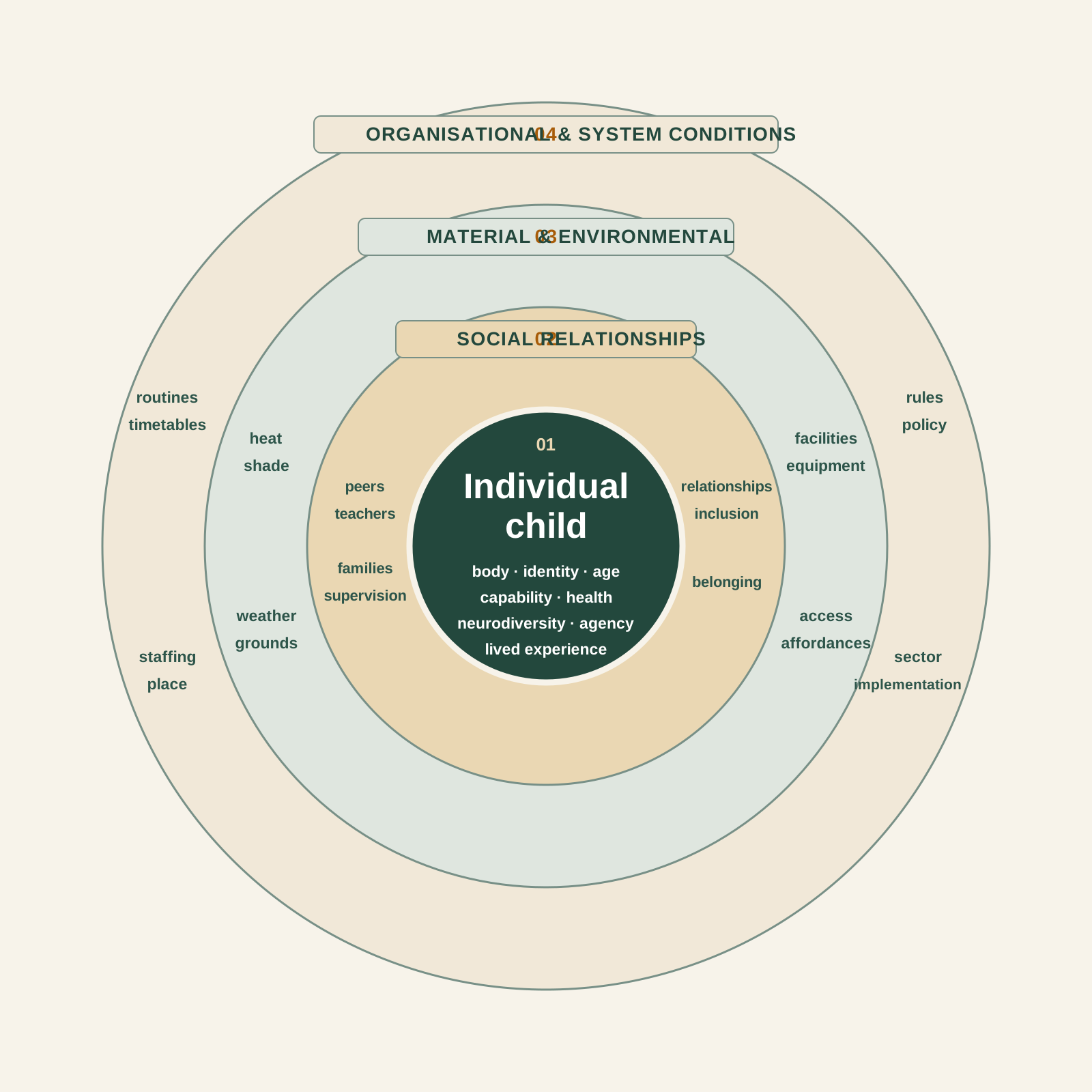
Children bring different bodies, identities, developmental stages, capabilities, health needs, neurodiversity, histories, preferences and forms of agency to the same school setting.
Relationships with peers and adults, supervision, expectations, permission, inclusion and belonging influence which opportunities become genuinely available.
Heat, weather, shade, grounds, facilities, equipment, sensory conditions and access shape what children can do, where and for how long.
Timetables, rules, staffing, routines, policies, sector arrangements and local implementation determine how intentions are enacted in practice.
Platform structure
Research foundations
These intervention studies and books trace the development of Brendon Hyndman’s research, with authorship and publication details in the original records.
Established an applied, child-centred and social-ecological approach to playground experience, participation and quality of life.
2017Springer research bookConnected individual, social, physical and policy influences with practical strategies for healthier school playgrounds.
2020Springer edited volumePositioned health, development and education as interacting conditions across the life course.
2023Routledge research bookExtended the program into heat, storms, climate exposure and the protection of school communities.
Selected evidence
Selected publications show the questions examined, the evidence available and the status of each contribution. Further records are linked from Brendon’s profile.
Accepted for publication · October 2026
Journal of Outdoor and Environmental Education
Schools experience very different rainfall conditions. Linking Australian Curriculum, Assessment and Reporting Authority school data with Bureau of Meteorology gridded monthly rainfall data, this national study maps how exposure was distributed across Australian schools in 2025.
The highest rainfall exposures were concentrated primarily in tropical Queensland, northern New South Wales and parts of the Northern Territory. Schools classified as high-rainfall using the 90th percentile threshold also had lower average socio-educational advantage than schools outside that zone.
A February to November sensitivity measure produced a similar exposure profile. The pattern was therefore not simply a result of rainfall during the main summer holiday period.
The findings position rainfall as an environmental condition of schooling, with implications for school grounds, recess, outdoor learning, infrastructure planning and educational equity.
The study maps rainfall exposure in 2025. It does not measure time spent outdoors or the amount of outdoor participation lost.
Schools are not only places where environmental issues are taught, but outdoor and material environments where education is lived under uneven climatic conditions. This study examined rainfall exposure as a condition shaping the possibilities for outdoor participation across Australian schools in 2025. Using a national cross-sectional spatial design, school-level Australian Curriculum, Assessment and Reporting Authority data were linked with Bureau of Meteorology gridded monthly rainfall data. Monthly rainfall was extracted for 11,025 schools and aggregated into annual, seasonal and core school-year exposure measures. Annual rainfall ranged from 57.99 mm to 5161.52 mm, with a national mean of 933.19 mm and a median of 788.96 mm. Exposure was geographically concentrated, with the highest values located primarily in tropical Queensland, northern New South Wales and parts of the Northern Territory. Using the 90th percentile threshold, 1,112 schools were classified as high-rainfall schools, representing more than 440,000 student enrolments. A February-November school-year sensitivity measure produced a similar exposure profile, indicating that the pattern was not simply an artefact of rainfall during the main summer holiday period. High-rainfall schools also had lower mean Index of Community Socio-Educational Advantage than schools outside the high-rainfall zone. These findings position rainfall as an underexamined outdoor and environmental condition of schooling, with implications for school grounds, recess, outdoor learning, infrastructure planning and educational equity.
Brendon Hyndman and Barbara Chancellor’s REPLAY study examines perceptions of outdoor school play among 234 parents and grandparents. Responses identify priorities for protected play time, playable school grounds and teacher support.
Examines 60 Australian public-education documents and shows that risk, supervision, climate exposure and adult responsibility are governed more clearly than play sufficiency, student agency, outdoor belonging and play-supportive adult capability.
Provides the international evidence base behind PlayReady and Play Latitude, drawing on 135 practising teachers across 25 countries.
Clarifies the language through which play is understood and enacted in education.
Connects professional learning and practical implementation with the conditions that shape school practice.
Positions outdoor play as a serious educational context for development, participation and learning.
Establishes the early applied foundation connecting playground conditions with children's enjoyment, physical activity and quality of life.
Research scope
Research belongs within the platform when it explains how everyday conditions shape participation, development, health, wellbeing, belonging or learning, and when it can inform better school or system decisions.